 AsaaseYaa
Growing yam in Ghana
When to plant, how far apart, which variety, how to feed it and which pests to watch for. The same guide the AsaaseYaa app uses to plan your yam jobs day by day.
When to plant
| Where | Season | Months |
|---|---|---|
| South and middle belt | Season 1 | Feb – Apr |
| Northern regions | Main Season | Mar – May |
In the app, the dates follow your region, and the jobs follow the rain forecast for your farm.
Getting the land ready
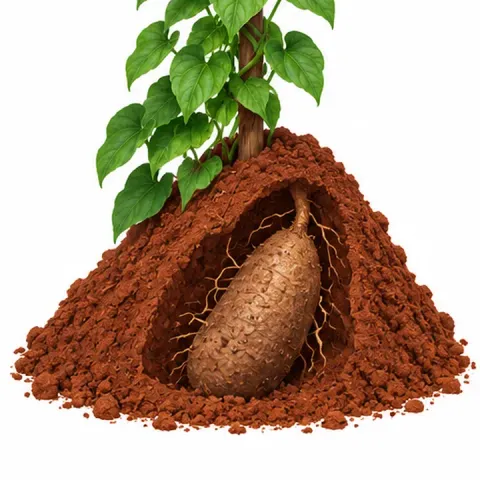
- Feeding: Compost or well-rotted manure. Yam responds well to organic matter. Build mounds with well-decomposed compost mixed into the top layer. Avoid fresh manure — it can cause rot at the pegged seed yam.
- Weeds: Deep ploughing to remove perennial weed rhizomes, then mound building. Spear grass (Imperata cylindrica) is the most problematic weed in yam. It must be thoroughly removed during land preparation — its rhizomes persist in the soil and regrow aggressively through mounds.
- Pests: Deep ploughing disrupts nematode populations. Source seed yam from healthy, certified stocks.
Varieties grown in Ghana
Premium white guinea yam — top market price, the variety farmers grow for sale not subsistence.
Reliable, high-yielding white yam. A safer bet than Pona if soils are average.
Matures faster than Pona/Laribako. Useful in years when planting is delayed.
White guinea yam, well-known in the south. Lower yield than Pona but suits forest-zone soils.
Care through the season
Establishment
- Feed: NPK 15-15-15, 30 g NPK per mound at 4–6 weeks after planting. Place 10 cm from emerging vine, cover with soil.
- Weed: Weed at 4–6 weeks, then every 3–4 weeks until vine covers mound.
- Watch for: Yam beetles, Nematodes, Yam anthracnose. Scout monthly.
Vegetative growth
- Feed: Urea 46% (optional), 20 g Urea per mound at 8–10 weeks after planting. Apply around base of vine, 15 cm away, water if dry.
- Weed: Weed at 8–10 weeks.
- Watch for: Yam mosaic virus, Scale insects, Mites. Scout every 2 weeks.
Bulking
- Weed: Rarely needed.
- Watch for: Yam beetles, Root rot. Scout monthly.
Pests and diseases
| Pest or disease | When it shows up |
|---|---|
| Yam beetles | Establishment, Bulking |
| Nematodes | Establishment |
| Yam anthracnose | Establishment |
| Yam mosaic virus | Vegetative growth |
| Scale insects | Vegetative growth |
| Mites | Vegetative growth |
| Root rot | Bulking |
Tap a name to see what it looks like and what to do. In the app, tap the leaf that looks like yours to see what is wrong. All pests: pest and disease library.
Harvest and storage
It is ready when:
- Vines are yellowing, wilting, and beginning to die back naturally
- Leaves have fallen or are fully yellowed — typically 7–9 months after pegging
- Tuber tip shows maturity — firm, not watery when probed
- Petioles (leaf stems) have dried and become brittle
Cut vines before digging to reduce moisture loss. Carefully loosen the mound with a fork or hoe from the side — do not stab the tuber. Lift by hand. Grade in the field, rejecting cracked or diseased tubers.
- Cure harvested yams by placing in a ventilated shade structure for 4–7 days — curing heals surface wounds and extends storage life significantly
- Do not wash before curing or storage
- Grade: separate seed yam pieces from sale yams
- Stack carefully in a yam barn on raised racks with good airflow between tubers
Properly cured yam stores for 4–6 months in a well-ventilated yam barn. Check monthly for rot — one rotten tuber spreads quickly. Treat any wound with wood ash to prevent fungal entry.
What to plant next
Move to a legume or cereal. Yam → soybean / maize. Repeat tuber cropping accelerates Scutellonema bradys (yam nematode) buildup. Legume rotation breaks the cycle.
General advice from crop guides for Ghana. Check important decisions with an agronomist or your district agriculture office.
Get your yam jobs day by day
AsaaseYaa turns this guide into picture steps for your farm, with reminders. Free.