 AsaaseYaa
Growing cassava in Ghana
When to plant, how far apart, which variety, how to feed it and which pests to watch for. The same guide the AsaaseYaa app uses to plan your cassava jobs day by day.
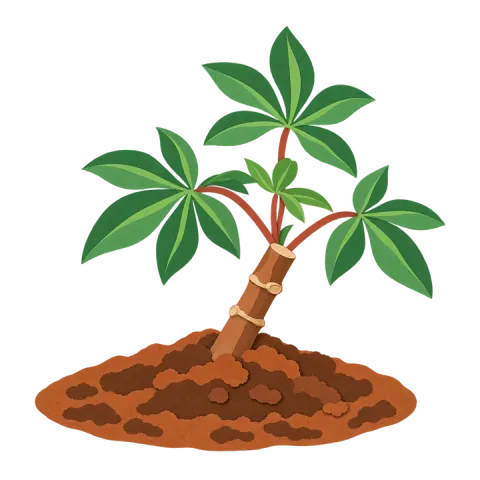
When to plant
| Where | Season | Months |
|---|---|---|
| South and middle belt | Season 1 | Mar – May |
| Northern regions | Main Season | Apr – Jun |
In the app, the dates follow your region, and the jobs follow the rain forecast for your farm.
Getting the land ready
- Feeding: Compost or organic matter. Incorporate compost if available. Cassava tolerates poor soils but responds well to improved organic matter at planting.
- Weeds: Thorough land preparation, remove perennial weed roots. Good land preparation is the most effective first step for cassava weed management. Remove rhizomes and roots of perennial weeds (like Imperata cylindrica / spear grass) during land clearing.
- Pests: Identify and treat termite mounds during land preparation. Source clean planting material from certified suppliers or verified healthy fields.
Varieties grown in Ghana
High-yielding white cassava with good mosaic virus tolerance. Suits both gari and chips processing.
Earlier maturity (10 months) than most. Tolerates cassava mealybug pressure.
Sweet variety — strong fresh-market demand for fufu and ampesi.
High starch content for industrial use; tolerates poorer soils.
Great for gari and industrial starch — high dry-matter roots with steady processor demand.
Care through the season
Establishment
- Feed: NPK 15-15-15, 50 kg per acre. Broadcast and lightly incorporate at 3–4 weeks after planting.
- Weed: Weed at 4–6 weeks, then monthly for 3 months.
- Watch for: Cassava mosaic disease (CMD), Cassava bacterial blight, Termites. Scout weekly for first month.
Vegetative growth
- Feed: Urea 46% (optional), 15 kg per acre (only if growth looks poor). Broadcast and lightly water in.
- Weed: Weed at 8–10 weeks.
- Watch for: Cassava mealybug, Whitefly, CMD (virus spread). Scout twice monthly.
Bulking
- Weed: Rarely needed.
- Watch for: Cassava green mite, Root rot (Pythium). Scout monthly.
Pests and diseases
| Pest or disease | When it shows up |
|---|---|
| Cassava mosaic disease (CMD) | Establishment |
| Cassava bacterial blight | Establishment |
| Termites | Establishment |
| Cassava mealybug | Vegetative growth |
| Whitefly | Vegetative growth |
| CMD (virus spread) | Vegetative growth |
| Cassava green mite | Bulking |
| Root rot (Pythium) | Bulking |
Tap a name to see what it looks like and what to do. In the app, tap the leaf that looks like yours to see what is wrong. All pests: pest and disease library.
Harvest and storage
It is ready when:
- Leaves are yellowing and beginning to fall — normal at 9–12 months for most varieties
- Roots are firm with adequate girth — check by digging a test root
- Bark peels easily from the root surface revealing white flesh
- Starch content is highest between 9–18 months depending on variety
Cut stems 30 cm above ground before digging. Loosen soil around the mound with a fork or hoe. Pull the root cluster by the remaining stem base. Harvest in stages — cassava holds well in the ground.
- Remove roots from field immediately — cassava deteriorates within 2–3 days of harvest
- Trim roots cleanly, removing small lateral roots and stem remnants
- Process immediately: peel and dry for gari, chips, or flour, or cover with wet sacking for fresh market
- Leave stems in field for next planting cycle — store upright in shade
Fresh cassava must be processed or sold within 48–72 hours. For storage: produce dried chips (sun-dry peeled slices for 3–4 days) or gari. Dried cassava stores for 6–12 months in clean bags.
What to plant next
Don't plant another root crop. Cassava → soybean or maize. Cassava is a K-heavy feeder; back-to-back tubers exhaust K and worsen mealybug carry-over.
General advice from crop guides for Ghana, including notes from a practising agronomist in Ghana. Check important decisions with an agronomist or your district agriculture office.
Get your cassava jobs day by day
AsaaseYaa turns this guide into picture steps for your farm, with reminders. Free.